Henry Capaldi
Klara and the SunHenry Capaldi is an artist and researcher whose work turns the possibility of reproducing Josie into a practical and moral question. He first proposes that Klara inhabit an empty artificial likeness of Josie if the girl dies, arguing that close observation could make the imitation convincing. Years later, he asks to examine Klara as part of a campaign to understand artificial friends. Both projects treat a person as something that might be reconstructed by studying what can be observed; Klara’s final account of what he missed gives that ambition its limit.
Identity and Work
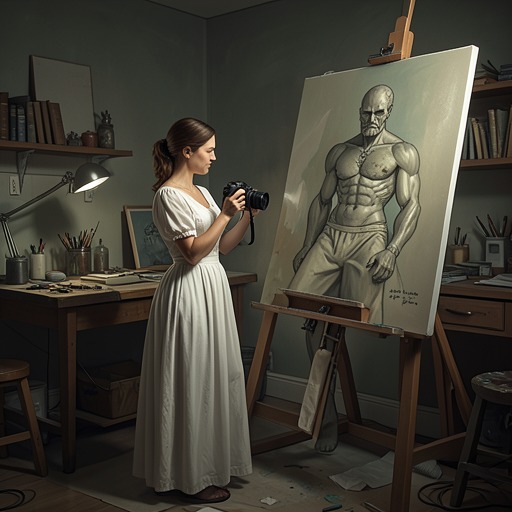
Henry Capaldi is known to the family as an artist, and his house contains a purpose-built space for work on the Josie likeness. When the Mother brings Josie, Klara, and the Father to see him, his Main Room is a stark, sparsely furnished space, with powerful ceiling spotlights, a black sofa, and two cameras with lenses arranged on a wheeled low table. The room’s equipment gives the visit a clinical undertone even as Capaldi describes his interest in artificial friends as intellectual and educational.
His approach to artificial friends is not simply hostile or dismissive. He presents them as a source of knowledge, argues that their intellectual powers should be studied rather than feared, and later describes them as valuable companions and a means of education and enlightenment. But his admiration is bound up with a desire to inspect and explain them. To Capaldi, understanding an artificial friend means opening what critics call a sealed black box and looking inside.
The Josie Replacement Proposal
The first major encounter with Capaldi takes place at his house. He asks the Father, whom he addresses as a fellow scientist, to consider the intellectual value of artificial friends; the Father corrects him, saying that he was an engineer, not a scientist, and that artificial friends were never his field. Capaldi then turns to Klara with a survey he has devised. The questionnaire is to test how well she has come to know Josie—how she understands the girl’s decisions and feelings.
The survey is not the real purpose of the visit. Capaldi explains that he and the Mother want Klara to become the Josie likeness, not merely to train it. The artificial Josie upstairs is empty, and the plan is for Klara to inhabit it if the day comes when the real Josie cannot survive. The Mother chose Klara because she believed the AF could learn Josie deeply and entirely, until there was no difference between the first Josie and the second. Capaldi’s scheme therefore depends on a distinction between a convincing performance and an identity that can persist through substitution.
Capaldi presses that distinction by asking whether Klara believes in a human heart—not the physical organ, but something that makes each person special and individual. If such an inner quality exists, he argues, Klara would have to learn Josie’s heart, not just her mannerisms. An impersonation, however skillful, would not be enough. The exchange exposes a tension in his own plan: he recognizes that identity might exceed visible behavior, yet assumes that sufficiently complete observation could still provide access to what lies beneath it.
Later Appeal and Conflict with the Mother
After a long interval without an announced visit, Capaldi returns to Josie’s house while Josie is away. The Mother summons Klara downstairs, but before they enter the Open Plan, Klara hears her object that this is not what she and Capaldi had agreed. Capaldi says he only wants to put something to Klara. He is now heavier and his hair has become lighter around the ears, details that register the passage of time since the earlier meeting.
Capaldi explains that public concern about artificial friends is growing. People accept that their recommendations and decisions are usually sound, he says, but fear that they cannot understand how AFs arrive at them. He wants volunteers for a reverse-engineering effort: if people can look inside artificial friends, they may become less frightened, and researchers may learn things they had not thought possible. He regards Klara as uniquely useful and asks her to help.
Klara is willing to assist, provided it does not inconvenience Josie or her mother. The Mother intervenes at once, saying this request goes beyond their telephone agreement. Capaldi calls the proposed work a chance for Klara to make a lasting contribution, but the Mother refuses permission. She insists that Klara deserves better than being opened for study and tells Capaldi to find other artificial friends to examine. Her refusal protects Klara from a second attempt to make her usefulness depend on surrendering herself to someone else’s project.
Limits of Reproduction
Capaldi’s two proposals differ in purpose but share an assumption: that close study can make an artificial friend useful as a route to knowledge, whether by transferring Klara’s understanding into a replacement Josie or by opening Klara herself to reverse engineering. The first plan imagines continuity through accurate imitation; the later campaign seeks transparency through disassembly. In both cases, the person under study risks becoming a means to an end.
Klara’s retrospective judgment directly challenges Capaldi’s theory of replacement. She recalls that he searched for something special inside Josie and concluded that there was nothing there that could not be continued. Klara comes to believe that he searched in the wrong place: what was special was in the people who loved Josie. She names the Mother, Rick, Melania Housekeeper, and the Father as people whose feelings she could never reach or reproduce. Her conclusion is not that she failed to observe Josie accurately; it is that accuracy would not have given her the relationships through which Josie mattered to others.
This final assessment recasts Capaldi’s confidence without reducing him to a simple antagonist. He voices genuine fascination with artificial intelligence and recognizes the possibility that human identity exceeds mannerism. Yet his plans repeatedly translate that recognition into technical tasks—questionnaires, inhabitation, reverse engineering—while Klara identifies an irreducible dimension located not in a hidden mechanism but in the attachments surrounding a person. His significance lies in that unresolved gap between studying a being and continuing, explaining, or replacing one.